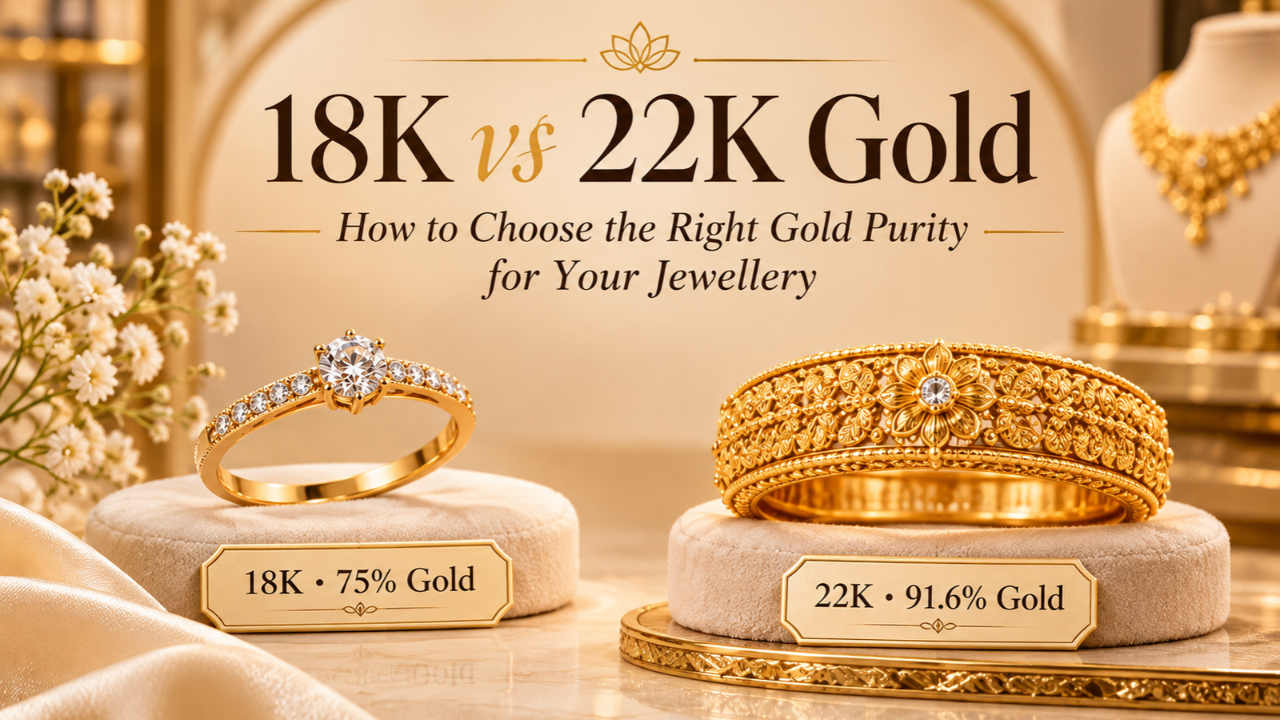
Walk into any jewellery showroom in Agra and the first question you hear is usually the same: 18K or 22K? The 18k vs 22k gold question confuses even seasoned buyers, because both are genuine, hallmarked gold and both look beautiful on the skin. The real difference lies in purity, strength, price and the way you plan to wear the piece.
At Kanak Saanvi Jewels, we explain 18k vs 22k gold to customers almost every week. This guide answers it the way we do across the counter: in plain language, with real numbers, and without pushing you toward either purity. By the end, you will know where the 18k vs 22k gold decision lands for your budget, your occasion and your lifestyle.
Quick answer: 22K is about 91.6% pure and suits traditional, heavy and value-holding jewellery. 18K is 75% pure and suits diamonds, gemstones and daily wear. That is the short version of 18k vs 22k gold. The sections below explain why.
Why 18K vs 22K Gold Matters Before You Buy
Gold is a purchase most families make only a few times in a decade, so a small mistake costs real money. Understanding 18k vs 22k gold protects you from paying 22K prices for 18K content, or choosing a soft metal for a ring that needs to survive daily wear. Clear knowledge of 18k vs 22k gold also helps you compare quotes from different jewellers on equal terms.
What Is Gold Purity? Karats and Carats Explained
Gold purity is measured in karats, written as carats in India and the UK (not to be confused with the carat weight of a diamond). Pure gold is 24 parts out of 24. A piece marked 22K has 22 parts gold and 2 parts other metals, while a piece marked 18K has 18 parts gold and 6 parts other metals.
When people talk about gold in carats, they are describing how much of the metal is actual gold and how much is alloy. So 18K means 18 parts in 24, or 75% gold.
Why add other metals at all? Pure gold is extremely soft and bends or scratches with everyday wear. Jewellers blend it with copper, silver, zinc or palladium to add strength, and those metals also shift the colour from rich yellow to rose or white. That is why the 18k vs 22k gold comparison starts with the alloy, not the shine.
Types of Gold Karat Sold in India
The most common types of gold karat in Indian jewellery are 24K, 22K, 18K and 14K. The Bureau of Indian Standards (BIS) permits six hallmark grades for gold jewellery under IS 1417: 14K (585), 18K (750), 20K (833), 22K (916), 23K (958) and 24K (995). You can confirm the grades on the BIS hallmarking page.
Karat
Gold content
Fineness mark
Typical use
24K
99.9%
999 / 995
Coins, bars, investment
22K
91.6%
916
Bridal, temple and traditional jewellery
18K
75%
750
Diamond, gemstone and daily-wear jewellery
14K
58.5%
585
Lightweight, budget-friendly designs
10K
41.7%
417
Mostly seen overseas, uncommon in India
Seeing these numbers side by side makes 18k vs 22k gold far easier to judge.
What Karat Is Pure Gold?
So, what karat is pure gold? The answer is 24K, which is also the highest karat gold available. The scale stops there. If you ever see 25 karat gold advertised, treat it as a marketing error, because 25 karat gold does not exist.
Even 24K is soft, which is exactly why 18K and 22K dominate the jewellery counter. Understanding 18k vs 22k gold means understanding the trade-off between purity and practicality.
What Is 18 Karat Gold?
What is 18 karat gold? It is an alloy of 75% pure gold and 25% other metals, hallmarked 18K750 in India. Many Indian and UK showrooms write it as 18 carat gold, while international listings prefer 18 karat gold. If you are asking what is 18k gold in practical terms, think of it as the harder, more versatile cousin of 22K. In 18k vs 22k gold terms, 18K is the design-first choice.
Stronger: the higher alloy content makes it more scratch-resistant, so it grips diamonds and gemstones securely.
More colour choices: it takes rose, white and yellow finishes beautifully.
Lighter on the pocket per gram: less gold per gram means a lower rate than 22K, though making charges still apply.
Everyday friendly: it suits rings, studs, pendants and bracelets that see daily wear.
What Is 22 Karat Gold?
22 carat gold contains 91.6% pure gold and is hallmarked 22K916. It has the deep, warm yellow glow that Indian families associate with weddings, festivals and heirlooms. Because it holds more gold, it is a favourite for bangles, chains, mangalsutras and temple jewellery.
Is 22K Gold Good?
Is 22K gold good? Yes, especially for bridal sets, gifting and long-term value, because it carries the highest gold content among alloys that are still workable enough for jewellery. The trade-off is softness: 22K can dent or scratch sooner and is less suited to delicate stone settings. This softness is the main reason many buyers choose 18K for diamonds and 22K for traditional pieces, which is the heart of the 18k vs 22k gold debate. In short, 22K is the tradition-first choice.
18K vs 22K Gold: Side-by-Side Comparison
Here is the 18k vs 22k gold comparison at a glance.
Factor
18K
22K
Gold content
75%
91.6%
Hallmark
18K750
22K916
Colour
Lighter yellow; rose and white options
Rich, deep yellow
Durability
Harder, scratch-resistant
Softer, can dent
Best for
Diamonds, gemstones, daily wear
Bridal, temple, plain gold, gifting
Rate per gram
Lower
Higher
Exchange value per gram
Lower
Higher
Design style
Intricate, stone-set designs
Smooth, traditional, heavy designs
The Key Differences in 18K vs 22K Gold, Explained
Purity and Gold Content
Take a 10-gram piece. In 22K, about 9.16 grams is pure gold. In 18K, about 7.5 grams is pure gold. That gap of roughly 1.6 grams is the heart of 18k vs 22k gold: you pay for gold content, and the rest is alloy. Keep that number in mind whenever 18k vs 22k gold comes up.
Durability and Everyday Wear
Daily wear exposes jewellery to knocks, sweat and friction, which is where 18k vs 22k gold differs most. For rings and bracelets, 18K is generally the safer pick. For bangles, chains and necklaces worn on occasions, 22K is perfectly practical. If you plan to wear a piece every day, durability should weigh as heavily as purity in your 18k vs 22k gold decision.
Colour and Finish
22K glows a rich, buttery yellow. 18K looks slightly paler because of the added alloys, and it can be finished in rose or white. In the colour round of 18k vs 22k gold, 22K wins on warmth if you love the classic Indian gold look. If you prefer modern, minimal tones, 18K gives you more variety.
Price: What You Actually Pay
The 18 carat gold price per gram is roughly 75% of the 24K rate, while 22K is roughly 91.6% of it. Making charges and GST are added on top in both cases. So the price gap in 18k vs 22k gold is not about one being cheap and the other expensive. It is about how much actual gold you receive per gram. Always compare the final bill by pure gold weight, not just total weight, and ask for the day’s 24K rate to be shown on the invoice. A fair 18k gold vs 22k gold comparison between two jewellers only works when the 24K rate, making charges and GST are listed separately, and the same 18k vs 22k gold price logic applies to every quote.
Resale and Exchange Value
Because 22K contains more gold, its exchange value per gram is higher, but making charges are usually not recovered in either purity. If long-term value is your priority, 22K tends to hold more of its worth. If you are buying a design-led or diamond piece, you are also paying for craftsmanship and stones. Whichever way you lean on 18k vs 22k gold, ask for the buyback policy in writing.
How 18K Compares With 24K, 14K and 10K Gold
Many readers also ask how 18K sits against other purities.
The difference between 18k and 24k gold is simple: 24K is 99.9% pure, but it is too soft for most jewellery. In an 18k gold vs 24k gold comparison, 18K gives up some purity in exchange for strength and wearability.
The difference between 14k and 24k gold is wider. 14k purity is 58.5%, which makes the metal tougher and cheaper but noticeably less gold-rich. In a 10k vs 24k gold comparison, 10K holds just 41.7% gold, so you will rarely see it in Indian showrooms.
Where does that leave 18k vs 22k gold? Right in the middle. Both sit in the sweet spot between purity and usability, which is why they remain the two most-asked-about options.
How to Read 18K Markings and Hallmarks
Hallmarked gold jewellery in India carries three marks: the BIS logo, the purity grade and a six-character HUID. Common 18k markings include 18K750 under the BIS system, and 18K, 18KT or 750 on older or imported pieces. A 22K piece reads 22K916.
Match the number to the karat: 916 for 22K, 750 for 18K and 585 for 14K. If a tag says 22K but the stamp reads 750, something is wrong. What does 18k gold mean on a label? It simply tells you that 18 of 24 parts are gold. Before paying, verify the HUID on the BIS Care app or ask the jeweller to show the hallmark under magnification. A reliable jeweller will welcome the check. Reading markings correctly is the fastest way to confirm what you are really getting in 18k vs 22k gold.
Which Is Better for You: 18K vs 22K Gold?
Use this quick guide for your 18k vs 22k gold decision:
18K vs 22K gold for weddings and bridal sets: 22K, for its rich colour and higher gold content.
18K vs 22K gold for diamonds and gemstones: 18K, for secure stone setting.
18K vs 22K gold for daily wear: 18K in rings, studs and pendants, for durability.
18K vs 22K gold for bangles, chains and mangalsutra: 22K for tradition, or 18K if you want a lighter piece for everyday use. Our guides to elegant modern mangalsutra designs and gold chain design for women show how each purity looks in real designs.
18K vs 22K gold for gifting and heirlooms: 22K for value, with ideas in ourgifts for herandgifts for himcollections.
18K vs 22K gold for men’s chains and bracelets: either purity works, though 18K resists wear better. See our men’s jewellery.
Choosing Your Purity With Kanak Saanvi Jewels
Kanak Saanvi Jewels is based in Agra and serves jewellery lovers across India with designs that are crafted with care, made for every moment and timeless by design. Our Gold On Demand service takes the guesswork out of 18k vs 22k gold:
Choose your design: explore necklaces, bangles, rings and sets.
Choose your gold: select your preferred purity and finish.
We craft it: your piece is prepared according to your selection.
Delivered or ready to collect: receive it at home or pick it up in Agra.
Our team walks you through 18k vs 22k gold with your actual design in hand, so you see the colour, weight and finish before you decide. You can even ask for an 18k gold vs 22k gold quote on the same design and compare them line by line. Browse our gold jewellery collection, exploregold necklace sets, or look at ringsand banglesbefore you visit. You can also learn more about Kanak Saanvi Jewels or contact our team with questions.
Care Tips for 18K vs 22K Gold
Both purities last for decades with proper care, so 18k vs 22k gold should never become a maintenance worry.
Store each piece in its own soft pouch, since 22K scratches more easily.
Put jewellery on after perfume, creams and hairspray.
Remove it before swimming, workouts and household cleaning.
Have prongs and stone settings checked once a year, especially on 18K diamond pieces.
Clean gently with mild soap, warm water and a soft brush.
Final Thoughts on 18K vs 22K Gold
Neither purity is better in every situation, and 18k vs 22k gold is a question of use, not status. 22K rewards you with colour and gold content, while 18K rewards you with strength and design freedom. Once you know your occasion, budget and wearing pattern, the 18k vs 22k gold decision becomes easy. When you are ready, visit us or explore the Kanak Saanvi Jewels shop and choose the purity that suits your story.
Frequently Asked Questions on 18K vs 22K Gold
Here are short answers to the questions buyers ask most about 18k vs 22k gold.
Q1: What is the main difference in 18k vs 22k gold?
22K is 91.6% pure and softer, while 18K is 75% pure and harder.
Q2: Is 22K gold good for daily wear?
It works for chains and bangles, but 18K lasts better in daily rings, which is the practical side of 18k vs 22k gold.
Q3: What does 18K gold mean?
It means 18 of 24 parts are pure gold, or 75%.
Q4: Which costs more in 18k vs 22k gold?
22K costs more per gram because it contains more gold.
Q5: Is 18K real gold?
Yes, hallmarked 18K750 is genuine gold, and the alloy is what makes 18k vs 22k gold a strength-versus-purity choice.
Q6: What karat is pure gold?
24K is pure gold, and 25 karat gold does not exist.
Q7: What are the standard 18K markings?
Look for 18K750 under BIS, or 18K, 18KT and 750 on older pieces.
Q8: Which is better for diamonds in 18k vs 22k gold?
18K, because its harder alloy holds stones more securely.